The MANIACs will enter the New Year with a bang on Thursday, January 27th when we welcome Barry Callen and Nell Weatherwax for a MANIAC Breakfast on "Improv Skills for the Workplace." We will meet at Memorial Union, 8-9:30am -- please register today for this free program! Barry and Nell bring a wealth of experience from their work with CORPROV Improv Training, an approach that applies improv skills to a wide range of workplace challenges.
Have fun! Learn some skills! Be a MANIAC!
Monday, December 27, 2010

Tuesday, December 7, 2010
Next MANIAC Breakfast Plants a Garden of Innovation
The next MANIAC Breakfast focuses on "Planting a MANIAC Garden" with Erin Schneider.What are the core qualities required for creative, collaborative, group thinking and problem-solving? How might these unique characteristics be reflected in a garden, where various plants, fruits, and vegetables co-exist in a healthy, sustainable ecosystem? These are questions that engage the mind of Erin Schneider, an organic farmer and MANIAC Team Member. Join us as we explore the ways Erin has sought to answer these questions, and to consider how these ideas can inform our own efforts to 'plant innovation seeds' in our organizations. Register now!
These bi-monthly gatherings allow us to share creative approaches to professional challenges, identify new tools and strategies that can help us transform creative ideas into innovative solutions, and promote relationships that can help us address emerging needs as they arise.
For additional information, contact Harry Webne-Behrman at OHRD, 608-262-9934 or hwebnebehrman@ohr.wisc.edu
These bi-monthly gatherings allow us to share creative approaches to professional challenges, identify new tools and strategies that can help us transform creative ideas into innovative solutions, and promote relationships that can help us address emerging needs as they arise.
For additional information, contact Harry Webne-Behrman at OHRD, 608-262-9934 or hwebnebehrman@ohr.wisc.edu
Wednesday, November 10, 2010
Connect at our next Jammin Innovative Facilitated Networking Session
Have you ever been to a bad networking session? Maybe there was no structure, it was a free-for-all at the beginning of a conference. Maybe it was a disguised as a happy hour at a bar. Maybe you didn’t get the chance to talk to anyone, or worse yet got stuck talking to someone for way too long. Maybe you just talked about the weather and didn’t get to talk about your idea or what you needed or provide any insight or assistance to anybody.
We've been working on innovating the networking session. Join us at our next Jam Session, it's like a facilitated workshop. It is part thinking about important questions, working on your "how you quickly communicate elevator speech," part group introduction, and part one-on-one or one-on-two speed networking. In this jam session people leave with a more comfortable and activity filled experience. They get to share with the whole group, hear from everyone, and go deeper one on one with many new people. They actually get to connect and converse!
Tuesday, November 2, 2010
Next Innovation Café Focuses on "Technology & Community" Nov 11th
Innovation and Collaboration Café: Technology & Community
Thursday, November 11, 8:30am-1:00pm, Pyle Center, $15
Join us at our next MANIAC Innovation Café!
This is an opportunity to explore a variety of technology tools and how they may be used to enhance innovation and collaboration in the workplace. The workshop will help participants recognize opportunities for technology tools in their workplace and projects; demonstrate the basics of web site design, social media (facebook/ twitter), blogs, surveys, and video conferencing; showcase good examples of technology use; and provide helpdesk support for real world technology questions. Register here! Or go to www.ohrd.wisc.edu, look for upcoming events.
You have MANIAC potential! Join us!
Thursday, November 11, 8:30am-1:00pm, Pyle Center, $15
Join us at our next MANIAC Innovation Café!
This is an opportunity to explore a variety of technology tools and how they may be used to enhance innovation and collaboration in the workplace. The workshop will help participants recognize opportunities for technology tools in their workplace and projects; demonstrate the basics of web site design, social media (facebook/ twitter), blogs, surveys, and video conferencing; showcase good examples of technology use; and provide helpdesk support for real world technology questions. Register here! Or go to www.ohrd.wisc.edu, look for upcoming events.
You have MANIAC potential! Join us!
Tuesday, October 19, 2010
December Innovation Workshop on Creativity, Communication, & Collaboration
UW-MANIAC is offering a motivating two afternoon innovation workshop in December. Registration is open for Developing Innovation through Collaboration, Creativity, & Communication.
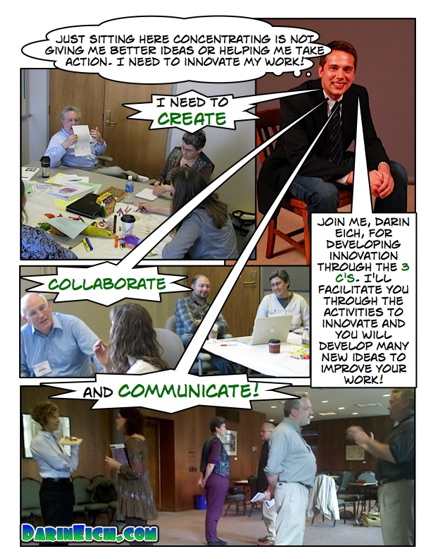
The Three C’s of Collaboration, Creativity, and Communication can help you to develop new innovations that can contribute to doing meaningful new things, improving processes for problem-solving, and having greater success in your work. You will meet new people and work with others to systematically generate and develop new ideas for the challenge of your choosing. Be guided step-by-step and activity-by-activity through an innovation process to develop and take action on new ideas for your real project. Learn the fundamental “best practice” activities for innovating and leave the workshop with more advanced innovation skills and a portfolio of new developed ideas.
By learning and using innovation tools and activities to create, collaborate, and communicate you will get important work done at this workshop away from the routine of your office. You will innovate how you work and create new innovations to take action on what is needed and wanted. New ideas that can make a difference in your work and life are motivating and engaging for you and your colleagues. Here are some key learning outcomes and actions we will take at the workshop:
Create:
+ Generate a wide range of relevant, new and different ideas based on
your challenge or opportunity through creative thinking tools.
+ Analyze, synthesize, and develop the best ideas into a portfolio of
concepts to act upon based on a best practice development system.
Collaborate:
+ Develop relationships quickly with fellow innovators to collaborate
in groups with at the workshop and beyond.
+ Connect one-on-one with fellow innovators through guided activities
designed to help you gain new insight and validation of your concepts.
Communicate:
+ Learn a simple and effective idea presentation format used by
innovative organizations that will allow you to showcase your new concepts.
+ Practice communicating your best concepts in ways that are engaging
and memorable using involvement, story, visuals, and metaphors.
Darin Eich is an innovation facilitator, researcher, and author who teaches individuals and organizations how to better ideate to innovate. Darin has a Ph.D. in Educational Leadership & Policy Analysis from the University of Wisconsin-Madison.
The Three C’s of Collaboration, Creativity, and Communication can help you to develop new innovations that can contribute to doing meaningful new things, improving processes for problem-solving, and having greater success in your work. You will meet new people and work with others to systematically generate and develop new ideas for the challenge of your choosing. Be guided step-by-step and activity-by-activity through an innovation process to develop and take action on new ideas for your real project. Learn the fundamental “best practice” activities for innovating and leave the workshop with more advanced innovation skills and a portfolio of new developed ideas.
By learning and using innovation tools and activities to create, collaborate, and communicate you will get important work done at this workshop away from the routine of your office. You will innovate how you work and create new innovations to take action on what is needed and wanted. New ideas that can make a difference in your work and life are motivating and engaging for you and your colleagues. Here are some key learning outcomes and actions we will take at the workshop:
Create:
+ Generate a wide range of relevant, new and different ideas based on
your challenge or opportunity through creative thinking tools.
+ Analyze, synthesize, and develop the best ideas into a portfolio of
concepts to act upon based on a best practice development system.
Collaborate:
+ Develop relationships quickly with fellow innovators to collaborate
in groups with at the workshop and beyond.
+ Connect one-on-one with fellow innovators through guided activities
designed to help you gain new insight and validation of your concepts.
Communicate:
+ Learn a simple and effective idea presentation format used by
innovative organizations that will allow you to showcase your new concepts.
+ Practice communicating your best concepts in ways that are engaging
and memorable using involvement, story, visuals, and metaphors.
Darin Eich is an innovation facilitator, researcher, and author who teaches individuals and organizations how to better ideate to innovate. Darin has a Ph.D. in Educational Leadership & Policy Analysis from the University of Wisconsin-Madison.
Tuesday, September 28, 2010
Next UW-MANIAC Breakfast - "Stone Tool Making and Innovation" with Jeff Shokler
The UW-MANIAC network is engaged in a wide array of innovative programming this fall, starting with last week's "Jammin' in the Fall" networking session and continuing with our first Breakfast Series event on October 12th at the Union.
"Stone Tool Making and Innovation: Old Technology and New Ways of Thinking" is Jeff Shokler's passion… How can a very old technology, chipped stone tool production, give us new ways to think about what we do and how we do it? Join us for a flintknapping demonstration and exploration of the insights and new/different ways of thinking this old process can reveal to us. If you don't get anything else out of it you'll still start the morning off with a "bang!" as you get to see someone break rocks and make sharp things!
The second part of our session will be a dialogue around the topic, "Harvesting Inter-generational Wisdom in the Workplace." Using Appreciative inquiry, an asset-based approach to understanding and addressing a wide range of issues, we will facilitate an initial conversation around this important topic effecting our workplaces. This idea was sparked at a spring MANIAC Café, and our plan is to explore innovative ways to build from the dialogue in future conversations.
To register, go to the course site. For additional information, contact Harry Webne-Behrman at OHRD, 262-9934 or hwebnebehrman@ohr.wisc.edu
Get involved! Become a MANIAC. Innovate. Collaborate. Inspire meaningful change.
"Stone Tool Making and Innovation: Old Technology and New Ways of Thinking" is Jeff Shokler's passion… How can a very old technology, chipped stone tool production, give us new ways to think about what we do and how we do it? Join us for a flintknapping demonstration and exploration of the insights and new/different ways of thinking this old process can reveal to us. If you don't get anything else out of it you'll still start the morning off with a "bang!" as you get to see someone break rocks and make sharp things!
The second part of our session will be a dialogue around the topic, "Harvesting Inter-generational Wisdom in the Workplace." Using Appreciative inquiry, an asset-based approach to understanding and addressing a wide range of issues, we will facilitate an initial conversation around this important topic effecting our workplaces. This idea was sparked at a spring MANIAC Café, and our plan is to explore innovative ways to build from the dialogue in future conversations.
To register, go to the course site. For additional information, contact Harry Webne-Behrman at OHRD, 262-9934 or hwebnebehrman@ohr.wisc.edu
Get involved! Become a MANIAC. Innovate. Collaborate. Inspire meaningful change.
Friday, August 27, 2010
100 million effect: Kauffman Foundation Program Seeks to Catalyze Large Scale Education Innovations
Posted by Darin Eich
When I heard about this opportunity I thought this had MANIAC potential. Maybe there is a MANIAC who will apply or maybe a mini model of this can be done at UW. The Kauffman Foundation is offering a bootcamp and salary funding to selected founders who have a startup idea that can impact at least 100 million people in education or generate $100 million in revenue rather quickly. Incubator models like this with bootcamps are becoming popular in the world of venture funding and programs like this could directly educate education.
This press release speaks to an innovation in improving education at the national level. Foundation sponsored programs like this that provide training, knowledge, network, resources, and some founder salary could encourage new innovations to improve education.
When I heard about this opportunity I thought this had MANIAC potential. Maybe there is a MANIAC who will apply or maybe a mini model of this can be done at UW. The Kauffman Foundation is offering a bootcamp and salary funding to selected founders who have a startup idea that can impact at least 100 million people in education or generate $100 million in revenue rather quickly. Incubator models like this with bootcamps are becoming popular in the world of venture funding and programs like this could directly educate education.
This press release speaks to an innovation in improving education at the national level. Foundation sponsored programs like this that provide training, knowledge, network, resources, and some founder salary could encourage new innovations to improve education.
New Kauffman Foundation program launches search for passionate, aspiring founders of high-growth, scalable education enterprises
(KANSAS CITY, Mo.) July 14, 2010 – The Department of Education’s Race to the Top competition isn’t the only program focused on dramatically improving education. Kauffman Labs for Enterprise Creation, an initiative of the Ewing Marion Kauffman Foundation, announced today a competitive search for up to 20 aspiring founders to launch high-growth, transformative companies in the education market.
Those selected for the Kauffman Education Ventures Program will be immersed in an intensive, hands-on program designed to catalyze the creation of companies with the potential to generate thousands of jobs and dramatic economic benefits.
“This program is the opportunity of a lifetime for high-potential entrepreneurs who don’t have the resources to quit their day jobs and take the leap of faith to start their businesses—businesses that they think will grow fast and transform education in a powerful way,” said Bo Fishback, vice president for Entrepreneurship at the Kauffman Foundation. “Education is a more than $1 trillion market where innovations can produce massive benefits to the world and also create huge change in the lives of individuals.”
The Education Ventures Program will equip founders with the time, resources and skills to take their ideas from thought to implementation.
Selected founders will receive six months of training and education on every aspect of running a business, personal coaching to bring their ideas to market and competitive compensation to focus full-time on their ventures. The program will include helping founders establish a brand, develop negotiation and presentation skills, go to scale, build financial models, validate the market, perform customer diligence, find funding, build a management team and develop a board of directors.
“The rapid pace of change in the education field in terms of technology, the growth of charter schools, new demands for post-secondary education and shifting priorities provide opportunities for entrepreneurs to catalyze their ideas,” said Sandy Miller, director of Advancing Innovation at the Foundation. “We are looking for the bold, visionary founders of entrepreneurial ventures that are poised to grow, show promise to be truly scalable and are able to adapt to the changes in the field.”
Through an open application process available to anyone over the age of 18 with a transformative idea, Kauffman Labs will identify up to 20 entrepreneurial concepts for the education market and work with the aspiring founders to establish their organizations. Candidates may be individual entrepreneurs or teams of up to three people. Businesses from concept through young startup that offer a product or service to help people learn, directly or indirectly, and could change the face of education are eligible. Successful candidates will need to travel to Kansas City for extended periods of time to attend training and education workshops but can otherwise live and work anywhere in the United States.
Individuals interested in learning more or applying should visit www.kauffmanlabs.org. Completed applications are due September 20, 2010.
About Kauffman Labs for Enterprise Creation
Part school and part business accelerator, Kauffman Labs for Enterprise Creation is a new approach to developing the next generation of high-growth firms. Tapping the Kauffman Foundation’s vast entrepreneurship knowledge and networks, the program seeks to accelerate the number and success of new firms by offering a new method for teaching and training entrepreneurs of dynamic, fast-growth, scalable businesses in a lab setting, while studying the “science of startups” in the process. For more information, visit www.kauffmanlabs.org.
-----
I originally featured this program on my innovationlearning.org blog and participated in their conference call on August 18th. At that point they had 850 people start the application! Other innovators I've talked to are excited about this program. Sounds like models like this are gaining traction. We need innovation in education in grand ways!
Wednesday, July 28, 2010
CEO's Poll Indicates Importance of Leadership in Creativity and Complexity
We MANIAC's have known for some time that we are engaged in worthwhile efforts that can result in some truly amazing solutions to perplexing problems. But it's always nice to receive some external validation, and this came in the form of a recent report published by IBM, cited in a cover story on the "Creativity Crisis" in Newsweek magazine. The IBM Report, based upon a survey of over 1500 CEO's across 60 countries, concluded that skills in leading through complexity were required for the 21st Century, and that this meant inviting creativty throughout the organization to address changes in buisiness models, infusing 'disruptive innovations' into planning processes, and otherwise managing ambiguity, uncertainty, and complexity.
Sounds like what MANIAC is all about, doesn't it? I encourage you to read the Newsweek article as well, as it cites a number of other interesting aspects regarding our education system and how it is failing to teach these core competencies, as well as research on creativity and brain research that shows the links across creative processes in the arts and engineering. To me, this points to the benefits of more personalized, holistic, integral approaches to education, such as those championed by Sir Kenneth Robinson, Parker Palmer, Alfie Kohn, and others (whose talks and books I encourage you to peruse), as well as insights shared by W. Brian Arthur in his recent book, The Nature of Technology. Arthur painstakingly charts the processes of innovative change across domains and history, concluding that we must both become expert within specific fields and simultaneously lower the boundaries across fields so we can encourage intentional infusions of ideas and perspectives that may not mesh with our dominant conceptual paradigms and modes of inquiry.
Finally, I want to encourage you to view a recent Charlie Rose interview on public television, in which he spoke with one of the Newsweek reporters (Ashley Merryman), the editor of Science magazine (Bruce Alberts), and a Harvard professor doing research in this field (Aaron Berkowitz).
What do you think about these things?
Harry
Sounds like what MANIAC is all about, doesn't it? I encourage you to read the Newsweek article as well, as it cites a number of other interesting aspects regarding our education system and how it is failing to teach these core competencies, as well as research on creativity and brain research that shows the links across creative processes in the arts and engineering. To me, this points to the benefits of more personalized, holistic, integral approaches to education, such as those championed by Sir Kenneth Robinson, Parker Palmer, Alfie Kohn, and others (whose talks and books I encourage you to peruse), as well as insights shared by W. Brian Arthur in his recent book, The Nature of Technology. Arthur painstakingly charts the processes of innovative change across domains and history, concluding that we must both become expert within specific fields and simultaneously lower the boundaries across fields so we can encourage intentional infusions of ideas and perspectives that may not mesh with our dominant conceptual paradigms and modes of inquiry.
Finally, I want to encourage you to view a recent Charlie Rose interview on public television, in which he spoke with one of the Newsweek reporters (Ashley Merryman), the editor of Science magazine (Bruce Alberts), and a Harvard professor doing research in this field (Aaron Berkowitz).
What do you think about these things?
Harry
Monday, June 28, 2010
New MANIAC Toolbox
Hello MANIACs!
I have developed a new resource tool for you to explore! I have collected the innovation and collaboration tools, exercises, articles, web links, and activities from past MANIAC events and posted them in a "Toolbox." Check it out here!
This reference tool will help you continue the learning from MANIAC café, soirée, and breakfast workshops in your everyday work.
If you have any additional links or resources you wish to share with the MANIAC community, please forward them to Sarah Hurley at shurley@ohr.wisc.edu
Happy toolbox browsing!
Tuesday, April 13, 2010
Wednesday, February 17, 2010
UW Innovation Competition Yields Fabulous Fruit!
The recent UW-Madison innovation competition for students yielded a great tool for treating fruit trees: the Automated Pest Elimination (APEL) system was developed by mechanical engineering student Tom Gerold, offering "a smarter way to spray" that is safer and more environmentally friendly. The overall competition, an annual event, provided a number of exciting ideas that you should check out.
It also invites the question to the UW-MANIAC community: Is there a role for us in sponsoring events that encourage the development and submission of creative ideas that could improve the campus?
Harry
It also invites the question to the UW-MANIAC community: Is there a role for us in sponsoring events that encourage the development and submission of creative ideas that could improve the campus?
Harry
Wednesday, January 6, 2010
Some of my Favorite Resources
Here's a quick list of some fabulous resources to inspire new thinking and actions for the new year:
1. Co-Intelligence Institute Toolbox
Describes all kinds of change processes, methods, and techniques -- and even provides the backstory, theory and additional resources if you want to go deeper.
http://www.co-intelligence.org/CIPol_ComunityProcesses.html
2. Human System Dynamics Institute
Chaos theory and complexity as applied to working with groups and organizations in meaningful and practical ways.
http://www.hsdinstitute.org/
3. Fostering Sustainable Behavior: Community Based Social Marketing
Contains articles, case studies, and strategies from social change practitioners (with an environmental lens); tools include: attitudes, branding, commitment, communication, convenience, education, feedback, framing, goal setting, incentives, norms, prompts, social diffusion.
http://www.cbsm.com/public/world.lasso
4. NuPolis: Scalable Innovations for Communities
Includes stories about what's working (and what isn't) to ramp up social innovation in the US; also has chapters of an online book called How Social Innovators are Transforming America's Communities.
http://www.cbsm.com/public/world.lasso
5. Social Innovation Exchange
More international in scope, lists case studies and articles in a variety of social change fields.
http://www.socialinnovationexchange.org/
6. UW School of Business: Business, Environment, and Social Responsibility program
This resource page contains all kinds of goodies -- "Books That Changed My Life", "UW Classes Not to be Missed," "Videos" which include lots of TED talk links, and "Things You Can Do To Live More Sustainably."
http://www.bus.wisc.edu/sustainability/resources/
May you be inspired!
Marian Farrior
1. Co-Intelligence Institute Toolbox
Describes all kinds of change processes, methods, and techniques -- and even provides the backstory, theory and additional resources if you want to go deeper.
http://www.co-intelligence.org/CIPol_ComunityProcesses.html
2. Human System Dynamics Institute
Chaos theory and complexity as applied to working with groups and organizations in meaningful and practical ways.
http://www.hsdinstitute.org/
3. Fostering Sustainable Behavior: Community Based Social Marketing
Contains articles, case studies, and strategies from social change practitioners (with an environmental lens); tools include: attitudes, branding, commitment, communication, convenience, education, feedback, framing, goal setting, incentives, norms, prompts, social diffusion.
http://www.cbsm.com/public/world.lasso
4. NuPolis: Scalable Innovations for Communities
Includes stories about what's working (and what isn't) to ramp up social innovation in the US; also has chapters of an online book called How Social Innovators are Transforming America's Communities.
http://www.cbsm.com/public/world.lasso
5. Social Innovation Exchange
More international in scope, lists case studies and articles in a variety of social change fields.
http://www.socialinnovationexchange.org/
6. UW School of Business: Business, Environment, and Social Responsibility program
This resource page contains all kinds of goodies -- "Books That Changed My Life", "UW Classes Not to be Missed," "Videos" which include lots of TED talk links, and "Things You Can Do To Live More Sustainably."
http://www.bus.wisc.edu/sustainability/resources/
May you be inspired!
Marian Farrior
Monday, January 4, 2010
12 Innovations of the '00s
As we turn the page on our recent decade, an article by Sarah Van Gelder of YES! Magazine has gotten me thinking... What were some of the most important innovations of the '00s? Let's start with Van Gelder's candidates, as she identified a dozen important innovations of the last decade:
1. People fell in love with local foods. There are now more than 5,000 farmers' markets in the U.S., up 13 percent in just one year, many new school vegetable gardens, and CSA. People turned their lawns into gardens, and asked grocery stores and restaurants to offer local foods.
2. A home-grown U.S. pro-democracy movement brought greater integrity to the elections process. This movement, built on the voting rights movement, began after the questionable election of 2000. Through public scrutiny, legal challenges, and mobilization of poll watchers, it was able to counter election manipulation, voter suppression, black box voting irregularities, and to begin restoring voting rights to felons who had served their terms.
3. Happiness got redefined. As people discovered that debt and overconsumption cause stress to families, the planet, and each of us, many turned instead to friends, family, good works, spirituality, and personal growth as the keys to a good life.
4. Media became radically decentralized and inclusive, with anyone able to report on events and to post video, tweets, photos, and commentary. Governments found secrecy much harder to come by. Fact checking became a participatory activity.
5. Prison overcrowding, budget shortfalls, and powerful advocacy turned the public against draconian prison terms and the drug war in favor of limited prison time for nonviolent offenses and alternatives like treatment and community service.
6. People went local to rebuild the economy. Instead of competing to get corporations to locate in their communities, they began building economies based on local strengths and local needs, striving to be green and to offer living wages and dignity to employees. Worker-owned cooperatives are at the leading edge of this movement, especially in abandoned rust-belt cities. The new focus is on sustainably meeting the needs of ordinary people, not the greed of Wall Street.
7. Populist resistance grew to corporate power and big government. This movement pushed back against bailed-out Wall Street banks, the domination of health insurance and Pharma in the health care debate, and the power of big coal and big oil. Right-wing think tanks and media tried to morph this populism into an anti-Obama movement, so far with limited success. (But if Obama continues to capitulate to a corporate agenda, he could be in trouble with populists across the political spectrum.)
8. The stage was set for nuclear abolition: A global consensus grew around the need to abolish nuclear weapons. In the United States, conservatives like George Shultz are advocates along with progressive leaders.
9. Indigenous people’s rights were recognized in an official United Nations declaration. Indigenous peoples began using their new-found clout to protect their ways of life and the biosphere, stewarding sources of invaluable cultural and biological diversity.
10. The United States elected an African-American president. While this didn't usher in a utopian post-racial society, it did show the power of multi-racial organizing. And it set the stage for long over-due remedies to racial disparities and segregation. But, as has been painfully clear, it does not guarantee progressive policies will come out of the White House.
11. A new guiding philosophy emerged based on respect for all people and all life. This approach is gaining power after both neoliberalism and neoconservatism proved themselves out of touch with the challenges faced by humanity – and out of ideas. The Earth Charter, formally launched in 2000, received endorsements of thousands of organizations representing millions of people during the ‘00s, revealing the potential for a new worldview to take hold based in environmental sustainability and social justice.
12. A “Survival” Movement swept the world; millions took action to confront the climate crisis, making changes at home and at work, greening cities, resisting coal and deforestation. Look to this movement to grow rapidly, post-Copenhagen.
While I think several of those identified in her article are important, and have potential to make significant innovations in the economic and political landscape, I think there are some other innovations that have vast potential worth noting. These include:
* Access to purified water through low tech solutions. These include the Kissi water filter, potter Tracy Hawkins Filter Pure system, and PlayPump International's great merry go 'round systems. The ramifications of these inventions and the not-for-profit movement supporting them can result in over 1 billion people having necessary access to clean water.
* Computer access through self-meshing systems: Mesh networks have the potential to link remote areas throughout the world and to decentralize internet service provision to hundreds of millions of people. When combined with educational programs and aid, such as through One Laptop Per Child, the impact can be leveraged in some amazing ways.
* The explosion of micro-lending programs: Starting with the work of organizations like Grameen Bank, for which Mohammed Yunus won the 2006 Nobel Peace Prize, a wide array of organizations has emerged over the past decade. These organizations tend to focus their efforts on small groups, especially women, in the most impoverished regions of the world, with the goal of breaking the cycle of poverty. These efforts result in extraordinary success stories and freedom from social and economic oppression. The multiplier effects of micro-credit are just beginning to be realized.
What innovations would you rate as most important this past decade? What do you think of the ideas offered by Sarah Van Gelder, or by me? Continue the conversation!
-Harry
1. People fell in love with local foods. There are now more than 5,000 farmers' markets in the U.S., up 13 percent in just one year, many new school vegetable gardens, and CSA. People turned their lawns into gardens, and asked grocery stores and restaurants to offer local foods.
2. A home-grown U.S. pro-democracy movement brought greater integrity to the elections process. This movement, built on the voting rights movement, began after the questionable election of 2000. Through public scrutiny, legal challenges, and mobilization of poll watchers, it was able to counter election manipulation, voter suppression, black box voting irregularities, and to begin restoring voting rights to felons who had served their terms.
3. Happiness got redefined. As people discovered that debt and overconsumption cause stress to families, the planet, and each of us, many turned instead to friends, family, good works, spirituality, and personal growth as the keys to a good life.
4. Media became radically decentralized and inclusive, with anyone able to report on events and to post video, tweets, photos, and commentary. Governments found secrecy much harder to come by. Fact checking became a participatory activity.
5. Prison overcrowding, budget shortfalls, and powerful advocacy turned the public against draconian prison terms and the drug war in favor of limited prison time for nonviolent offenses and alternatives like treatment and community service.
6. People went local to rebuild the economy. Instead of competing to get corporations to locate in their communities, they began building economies based on local strengths and local needs, striving to be green and to offer living wages and dignity to employees. Worker-owned cooperatives are at the leading edge of this movement, especially in abandoned rust-belt cities. The new focus is on sustainably meeting the needs of ordinary people, not the greed of Wall Street.
7. Populist resistance grew to corporate power and big government. This movement pushed back against bailed-out Wall Street banks, the domination of health insurance and Pharma in the health care debate, and the power of big coal and big oil. Right-wing think tanks and media tried to morph this populism into an anti-Obama movement, so far with limited success. (But if Obama continues to capitulate to a corporate agenda, he could be in trouble with populists across the political spectrum.)
8. The stage was set for nuclear abolition: A global consensus grew around the need to abolish nuclear weapons. In the United States, conservatives like George Shultz are advocates along with progressive leaders.
9. Indigenous people’s rights were recognized in an official United Nations declaration. Indigenous peoples began using their new-found clout to protect their ways of life and the biosphere, stewarding sources of invaluable cultural and biological diversity.
10. The United States elected an African-American president. While this didn't usher in a utopian post-racial society, it did show the power of multi-racial organizing. And it set the stage for long over-due remedies to racial disparities and segregation. But, as has been painfully clear, it does not guarantee progressive policies will come out of the White House.
11. A new guiding philosophy emerged based on respect for all people and all life. This approach is gaining power after both neoliberalism and neoconservatism proved themselves out of touch with the challenges faced by humanity – and out of ideas. The Earth Charter, formally launched in 2000, received endorsements of thousands of organizations representing millions of people during the ‘00s, revealing the potential for a new worldview to take hold based in environmental sustainability and social justice.
12. A “Survival” Movement swept the world; millions took action to confront the climate crisis, making changes at home and at work, greening cities, resisting coal and deforestation. Look to this movement to grow rapidly, post-Copenhagen.
While I think several of those identified in her article are important, and have potential to make significant innovations in the economic and political landscape, I think there are some other innovations that have vast potential worth noting. These include:
* Access to purified water through low tech solutions. These include the Kissi water filter, potter Tracy Hawkins Filter Pure system, and PlayPump International's great merry go 'round systems. The ramifications of these inventions and the not-for-profit movement supporting them can result in over 1 billion people having necessary access to clean water.
* Computer access through self-meshing systems: Mesh networks have the potential to link remote areas throughout the world and to decentralize internet service provision to hundreds of millions of people. When combined with educational programs and aid, such as through One Laptop Per Child, the impact can be leveraged in some amazing ways.
* The explosion of micro-lending programs: Starting with the work of organizations like Grameen Bank, for which Mohammed Yunus won the 2006 Nobel Peace Prize, a wide array of organizations has emerged over the past decade. These organizations tend to focus their efforts on small groups, especially women, in the most impoverished regions of the world, with the goal of breaking the cycle of poverty. These efforts result in extraordinary success stories and freedom from social and economic oppression. The multiplier effects of micro-credit are just beginning to be realized.
What innovations would you rate as most important this past decade? What do you think of the ideas offered by Sarah Van Gelder, or by me? Continue the conversation!
-Harry
Subscribe to:
Posts (Atom)